
Pool Volume Calculator Gallons
Almost every pool chemical dose starts with one number: how many gallons your pool holds. Choose your pool’s shape, enter its size and depths, and this calculator gives the volume in US gallons, litres and cubic feet, estimates how long a hose will take to fill it and what the water will cost, and shows dose figures scaled per 10,000 gallons.
- Free to use
- No sign-up
- Runs in your browser
Pool volume calculator
Pool Care Printables
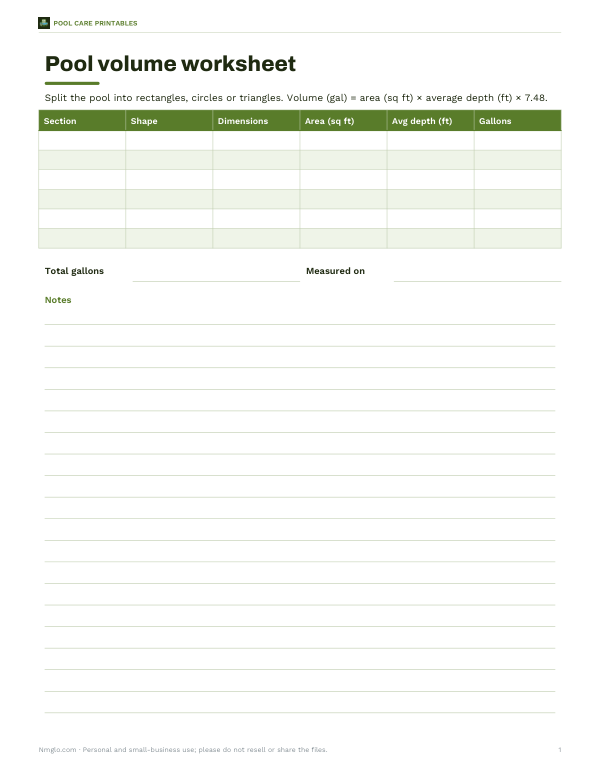
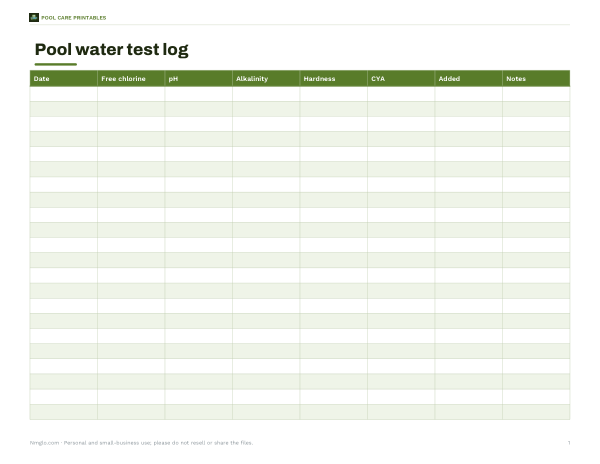
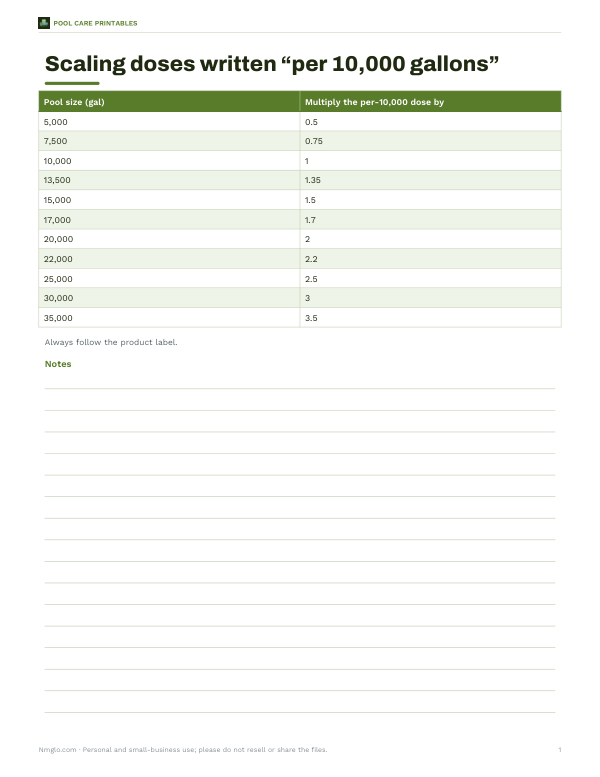
Printable pool volume worksheet for complex shapes, a weekly water test log, a dosing chart scaled per 10,000 gallons and an opening and closing checklist.
- Volume worksheet (PDF/DOCX)
- Water test log (PDF/DOCX/XLSX)
- Dosing scale (PDF/XLSX)
- Opening & closing (PDF/DOCX)
Formats: PDF, DOCX, XLSX. Instant download after payment (link valid 72 hours, up to 5 downloads). AI-assisted: the templates were drafted with AI help and reviewed and laid out before publishing.
$3.00 USD, one-time 4 files · about $0.75 each
- Instant download
- 7-day refund
- Secure checkout by Stripe
7-day money-back guarantee. Full refund within 7 days of purchase, even after you download.
Free sample: Dosing Scale Chart (PDF, 54 KB)
Full refund within 7 days — see the refund policy and license.
Free printables
Single sheets you can print right now, no sign-up. The full pack adds every sheet in one download plus the editable files.
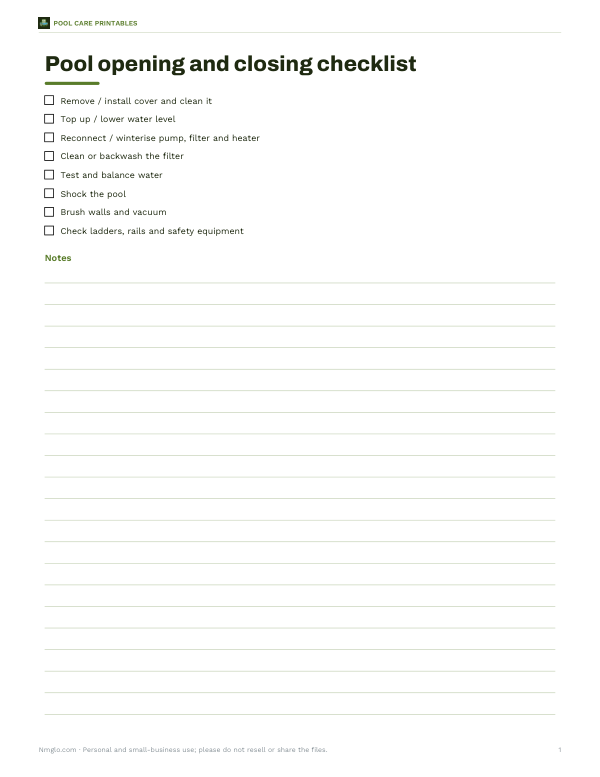 Pool Opening and Closing Checklist
Pool volume formulas
| Shape | US gallons (feet) | Litres (metres) |
|---|---|---|
| Rectangle | length × width × average depth × 7.48 | L × W × avg depth × 1,000 |
| Round | diameter² × average depth × 5.9 | 0.785 × D² × avg depth × 1,000 |
| Oval | length × width × average depth × 5.9 | 0.785 × L × W × avg depth × 1,000 |
| Kidney | (width A + width B) × length × average depth × 3.38 | 0.45 × (A + B) × L × avg depth × 1,000 |
| L-shape | Add two rectangles | Add two rectangles |
One cubic foot holds 7.48 US gallons, and one cubic metre holds 1,000 litres. The 5.9 factor for round and oval pools is 7.48 × π/4.
Average depth
For a pool with a shallow end and a deep end, the average depth is (shallow + deep) ÷ 2 when the bottom slopes evenly. Measure to the water line, not the top of the wall — water usually sits a few inches below the coping. If the deep end is only a small hopper, the true average is closer to the shallow depth; divide the pool into sections for a better figure.
Worked example
A 32 × 16 ft rectangular pool with a 3.5 ft shallow end and 8 ft deep end has an average depth of 5.75 ft. Its volume is 32 × 16 × 5.75 × 7.48 ≈ 22,000 gallons (about 83,400 litres). A garden hose running at 9 gallons a minute would take about 41 hours to fill it, and at $5 per 1,000 gallons the water would cost about $110. A dose written as “per 10,000 gallons” needs to be multiplied by 2.2.
Common pool sizes
| Pool | Typical volume |
|---|---|
| 12 ft round above-ground, 4 ft deep (water ~3.5 ft) | about 3,000 gallons |
| 18 ft round above-ground, 52 in wall | about 7,600 gallons |
| 24 ft round above-ground, 52 in wall | about 13,500 gallons |
| 16 × 32 ft in-ground, 3–6 ft | about 17,000 gallons |
| 20 × 40 ft in-ground, 3.5–8 ft | about 34,000 gallons |
Above-ground volumes assume water about 4 ft deep in a 52 in wall.
Why the volume matters
- Chlorine, shock, pH and alkalinity adjusters, salt and algaecides are all dosed by volume.
- Pump and filter sizing depends on turning over the whole volume in a set time (often around 8 hours).
- Heater sizing and heating cost depend on how much water you need to warm.
- Filling and draining plans depend on it too.
Pump turnover
Turnover is the time the pump takes to circulate the full volume once. For a 22,000-gallon pool, an 8-hour turnover needs a flow of 22,000 ÷ 8 ÷ 60 ≈ 46 gallons per minute. Check your pump’s flow at your system’s resistance, not just its maximum rating.
Measuring an irregular pool
- Sketch the pool from above and split it into rectangles, circles, half-circles and triangles.
- Measure each piece at the water line.
- Measure depths at several points along the length and average them, or use shallow and deep ends for each section.
- Work out each section’s volume and add them.
- For a kidney pool, the formula here (0.45 × (A + B) × length) is a common approximation, where A and B are the widths of the two lobes.
Water loss and top-ups
Pools lose water to evaporation, splash-out and backwashing. In hot, dry, windy weather, evaporation can be around a quarter of an inch a day. For a 32 × 16 ft pool, a quarter inch is 32 × 16 × 0.021 × 7.48 ≈ 80 gallons a day — useful for spotting a leak: if the level drops much faster, investigate. A bucket test (a bucket of pool water on the step, compared over 24 hours) helps separate evaporation from leaks.
Filling tips
- Ask your water supplier whether you can get a sewer-charge credit for filling a pool, or whether bulk water delivery is cheaper.
- Use more than one hose to shorten fill time.
- Test and balance the water as soon as it is full — fill water varies in pH, hardness and metals.
- Avoid filling a vinyl-lined pool too fast without keeping the liner in place.
Pool care pack
The optional pack includes a printable pool volume worksheet for complex shapes, a weekly water test log, a chemical dosing chart scaled per 10,000 gallons and an opening and closing checklist. The calculator above is free.
AI-assisted content
This page was drafted with AI assistance and reviewed before publishing. Follow chemical manufacturers’ labels for doses and safety.
Frequently asked questions
How do I calculate pool gallons?
Length × width × average depth × 7.48 for rectangular pools; diameter² × depth × 5.9 for round.
How many gallons is a 24 ft round pool?
About 13,500 gallons with a 52 in wall filled to about 4 ft.
How do I find average depth?
(Shallow depth + deep depth) ÷ 2 for an evenly sloped bottom.
How long does it take to fill a pool with a hose?
Volume ÷ hose flow; a 22,000-gallon pool at 9 gpm takes about 41 hours.
How many litres are in a gallon?
3.785 litres per US gallon.
Does it work in metric?
Yes, switch to metres and litres.
How many gallons in a cubic foot?
About 7.48 US gallons.
How much water does a pool lose to evaporation?
Often about a quarter inch a day in hot, dry, windy weather — more than people expect.